
The Government, through the Uganda Land Commission (ULC) in collaboration with the Ministry of Lands, Housing and Urban Development, has intensified nationwide stakeholder engagements aimed at strengthening the management, protection and administration of Government land and informing the development of a Comprehensive Government Land Inventory.
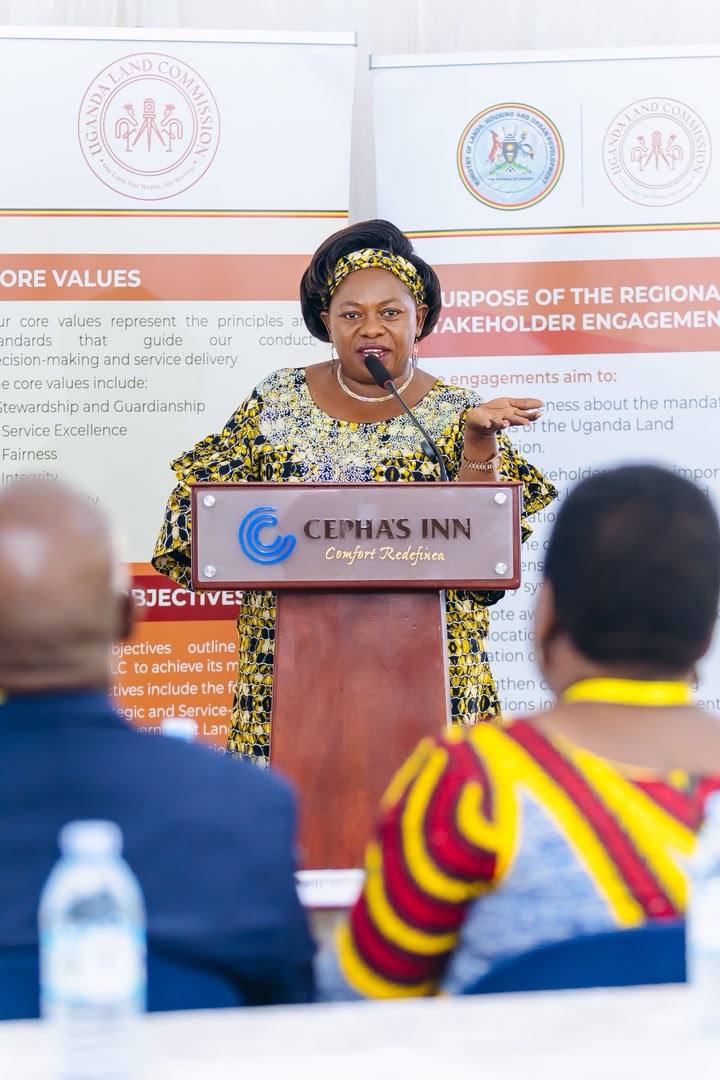
The engagements, which have been ongoing across different regions of the country in recent weeks, have so far been held in areas including Mukono, Masaka, Mbarara and Kabale, with more regions expected to participate in the exercise. The initiative seeks to build a common understanding among stakeholders on the importance of knowing, documenting, protecting, planning for and responsibly managing Government land.
The engagements are part of a nationwide process that was officially launched during the National Stakeholders Workshop held in Kampala on 7th July 2026. According to the Minister of State for Lands, Hon. Harriet Ntabazi, the regional consultations are intended to translate the national initiative into practical action at district and community level, while providing an opportunity for stakeholders to share their experiences, challenges and recommendations.

The stakeholders are being sensitized on the mandate and functions of the Uganda Land Commission, as well as the importance of proper documentation and inventory of Government land. The consultations are also providing a platform to gather views and recommendations to inform the development of the Comprehensive Government Land Inventory, enhance understanding of lawful procedures governing the allocation, administration, management and utilization of Government land, and strengthen coordination among institutions responsible for land governance.
The exercise is particularly focused on addressing challenges affecting Government land, including encroachment, illegal occupation, inadequate or outdated records, unclear boundaries, inadequate surveying and disputes. The Minister noted that public land reserved for schools, health facilities, roads, markets, administrative offices and other public purposes can gradually be lost through occupation, development or fraudulent transactions. She cautioned that failure to protect such land could force Government to purchase land again in the future, often at a much higher cost to taxpayers.
The development of the Comprehensive Government Land Inventory is therefore intended to establish a reliable information base showing what Government owns, where the land is located, its size and boundaries, who is responsible for each property, how it is being utilized and whether it is undocumented, threatened, encroached upon or under dispute. The Minister emphasized that the inventory should not merely become a document kept on a shelf, but should provide information that supports planning, budgeting, infrastructure development, investment and informed decision-making, while being regularly updated.
The regional engagements are also highlighting the link between Government land management and physical planning. As towns and urban centers expand, stakeholders are being encouraged to ensure that public land is properly integrated into physical development plans while taking environmental considerations into account, particularly in relation to forests, wetlands, lakeshores and other ecologically sensitive areas.
The Ministry and ULC have called for active participation from District Land Boards, Chief Administrative Officers, Town Clerks, District Land Officers, physical planners, surveyors, natural resources officers, political leaders, religious institutions, professional bodies, civil society organizations, the private sector and communities. Their local knowledge is considered critical to identifying Government land, existing challenges and areas requiring technical intervention.
The Minister further clarified that the exercise is not intended to take away lawfully owned private land. She stated that the inventory must be undertaken professionally, transparently and within the law, with clear ownership respected and legitimate disputes handled through the appropriate legal and administrative mechanisms. Where Government records are incomplete, verification is to be undertaken rather than relying on assumptions.
The regional consultations are consequently expected to promote accountability, transparency and efficiency in the management of Government land while generating recommendations that can inform policy, legal and institutional reforms. Stakeholders have been encouraged to raise cases  of encroachment, documentation gaps, boundary challenges and disputes, while also sharing successful practices that can be replicated in other districts.
The Minister noted that the Comprehensive Government Land Inventory is ultimately about more than land records. It is about protecting public assets, safeguarding taxpayers’ money, supporting orderly physical development and securing land for future schools, hospitals, roads, markets and other public investments. She called upon Central Government, Local Governments, communities, religious institutions, professionals, civil society and the private sector to work together to ensure that Government land is properly documented, protected, planned and managed for the benefit of Ugandans today and future generations.
The ongoing regional stakeholder engagements therefore mark an important step in building a comprehensive and reliable Government land information base and strengthening collective responsibility for the protection and sustainable management of public land across Uganda.